
Introduction
As the Bay Area transitions from the dry, dusty summer months into early fall, facility managers in high-traffic environments notice a familiar pattern. The daily cleaning crew arrives, mops the floors, empties the trash, and the space appears presentable. Yet, by mid-morning, the floors in retail storefronts and medical clinic waiting areas already look dull, scuffed, and worn. This is not a failure of the daily cleaning staff. It is a fundamental limitation of daily maintenance protocols.
Summer foot traffic tracks in a specific type of debris: fine, abrasive particulate matter. While daily porters excel at removing visible spills and surface litter, their standard equipment and neutral cleaning solutions are not designed to extract microscopic grit that has been pressed into floor finishes and porous grout lines. Left unaddressed, this embedded grime quietly degrades capital assets and introduces hidden safety liabilities just as businesses prepare for the intense operational demands of the fourth quarter.
The Mechanics of Silent Degradation
To understand why daily cleaning falls short, it is necessary to examine the physical mechanics of floor wear. When pedestrians walk across a commercial space, the weight of their footsteps acts as a press, forcing fine sand, dirt, and urban grit into the microscopic pores of floor finishes and tile surfaces.
Daily porters typically use auto-scrubbers or mop-and-bucket systems with neutral pH cleaners. These solutions are excellent for breaking down organic spills and maintaining surface sanitation. However, they lack the chemical agitation or mechanical extraction power required to dislodge particulate matter that has been compacted beneath the surface sealant.
Consequently, the next day, when foot traffic resumes, that trapped grit acts like fine-grit sandpaper. Every step grinds the particulate deeper into the finish, creating micro-scratches. These micro-scratches do two things. First, they scatter light, making the floor appear permanently dull and dirty regardless of how recently it was mopped. Second, they create a rougher surface texture that actually traps new dirt more rapidly, accelerating the cleaning cycle and increasing labor costs without improving the visual or structural outcome. This is silent degradation. It does not trigger an immediate maintenance ticket, but it systematically shortens the lifespan of the flooring material.
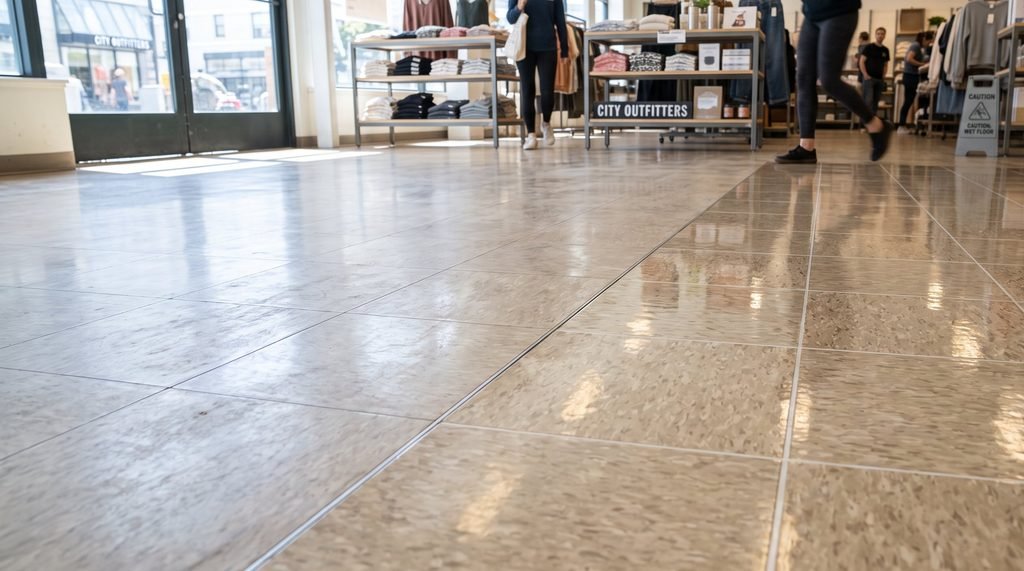
A close-up, high-contrast photograph of a commercial retail floor showcasing the stark difference between a dull, surface-mopped section and a professionally extracted area with restored finish clarity.
The Grout Line Liability in High-Traffic Zones
The risk of embedded grime is particularly acute in environments featuring tile and grout, such as medical facility waiting rooms, clinic corridors, and retail entryways. Grout is inherently porous. During the summer months, a combination of dry dust, tracked-in moisture, and high foot volume forces contaminants deep into these grout lines.
Daily cleaning protocols rarely address the depth of the grout joint. A standard mop merely glides over the top, pushing surface debris around without extracting what lies beneath. Over time, this accumulation creates two distinct operational risks.
The first is a hygiene and compliance concern. In medical facilities, porous grout that harbors embedded organic matter can become a reservoir for bacteria, compromising the sterile environment that patients and health inspectors expect. The second risk is physical safety. As grout lines fill with compacted debris and lose their original texture, the slip resistance of the floor changes. What begins as a cosmetic issue of darkened grout lines can quickly evolve into a documented slip-and-fall liability, especially in areas prone to occasional moisture exposure.
The Financial Math of Deferred Floor Maintenance
Facility managers are constantly balancing operational budgets against capital expenditures. When floor degradation is addressed reactively rather than proactively, the financial math rarely favors the business.
Consider the cost trajectory of deferred floor maintenance. If embedded grit is allowed to compromise the floor finish throughout the summer, the facility will eventually require a complete strip-and-wax procedure or, in severe cases, partial floor replacement. Scheduling this intensive work during the fourth quarter is highly disruptive. For a retail store, closing a section of the floor during the holiday shopping season directly impacts revenue. For a medical clinic, relocating patient flow during winter flu season compromises care delivery and staff efficiency.
Conversely, scheduling a specialized deep cleaning and floor treatment in late summer or early September offers significant financial advantages. The facility can control the timing of the disruption, often scheduling the work after hours or during historically slower periods. The cost of a targeted late-summer intervention is a fraction of the cost of premature capital replacement, and it preserves the existing asset for years to come.
How Operations Leaders Structurally Address the Gap
Professional facility management does not view daily porters and specialized cleaning as competing services. They are complementary layers of a comprehensive maintenance strategy. Daily porters maintain the baseline hygiene and appearance of the space. Specialized interventions address the structural wear that daily cleaning cannot reach.
Operations leaders mitigate late-summer floor degradation by integrating three specific services into their annual maintenance calendar.
First, Specialized Deep Cleaning is deployed to extract the compacted particulate matter from high-traffic zones. This process utilizes industrial-grade extraction equipment and specialized solutions designed to break the bond between the grit and the floor surface without damaging the underlying material.
Second, Detailed Tile and Grout Cleaning targets the porous joints that standard mopping misses. By thoroughly cleaning and, when necessary, sealing the grout lines, facilities restore the slip resistance of the floor and eliminate harborage points for bacteria, directly supporting health and safety compliance.
Third, Advanced Floor Treatment is applied to restore the protective barrier of the flooring. Whether this involves stripping and recoating a vinyl composition tile floor or polishing a hard surface, this step seals the micro-scratches created by summer foot traffic, returning the floor to a smooth, light-reflecting state that is easier for daily porters to maintain moving forward.
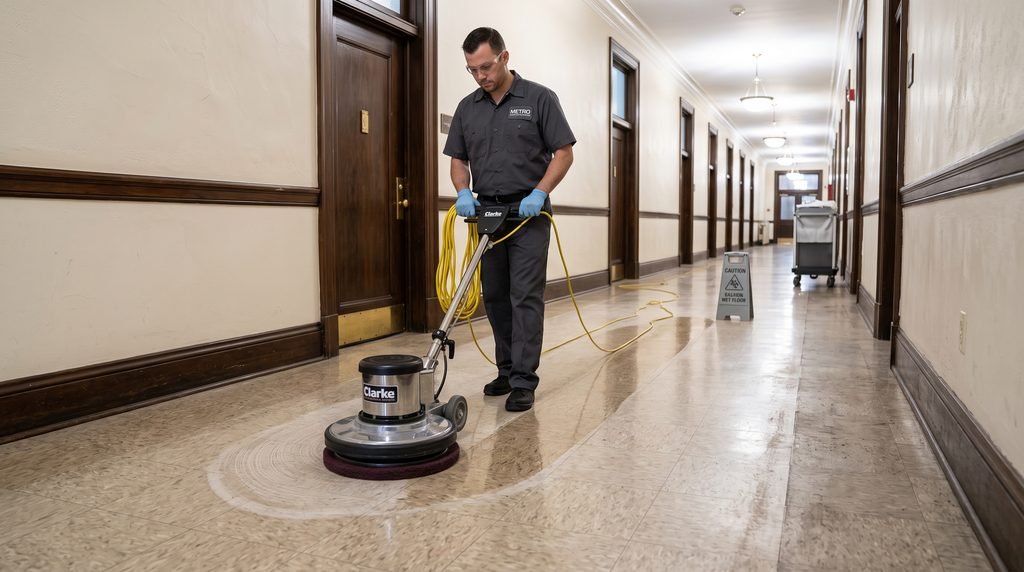
An action shot of a cleaning technician operating a low-speed, industrial-grade floor buffer in a commercial hallway, highlighting the methodical, deep-cleaning process essential for removing structural grime.
Closing Insight
Operational excellence is rarely about reacting to visible failures. It is about anticipating wear and intervening before a minor issue compounds into a major liability. The transition from summer to fall is not merely a change in weather; it is a critical operational window. A late-summer floor reset is not a cosmetic upgrade. It is a deliberate preservation strategy that protects your capital assets, reduces safety risks, and ensures your facility is structurally prepared for the demands of the fourth quarter.
Call to Action
If your facility is approaching its Q4 peak, now is the optimal time to evaluate your floor maintenance schedule. Contact our team to discuss a tailored assessment of your high-traffic zones and explore how a structured late-summer reset can protect your operational continuity.