

A busy Saturday afternoon in a San Francisco or San Jose retail district presents a specific operational reality. The doors keep opening. By mid-afternoon, the restroom soap dispensers are empty, the floors near the entrance are heavily scuffed, and the common area trash bins are overflowing. This scenario is rarely a failure of effort by the evening cleaning crew. Instead, it represents a structural mismatch between static cleaning schedules and dynamic foot traffic.
When summer tourism, outdoor festivals, and local events drive a significant increase in daily visitors, standard commercial cleaning protocols break down. The physical environment degrades faster than the existing maintenance plan can address. For facility managers and business owners, this seasonal surge transforms cleaning from a routine operational task into a critical risk management challenge. Understanding how to align your maintenance protocols with peak volume is essential for protecting your operational continuity and regulatory standing.
The Mechanics of High-Traffic Degradation
Restrooms and entryways degrade exponentially rather than linearly as foot traffic increases. Standard janitorial schedules are typically built for baseline occupancy. A restroom designed to serve two hundred daily users operates under completely different physical stresses when serving eight hundred users. Soil is tracked in at a much faster rate. High-touch surfaces accumulate biological loads more quickly. Supply depletion outpaces the standard hourly check.
This accelerated degradation matters because health inspectors do not grade on a curve. A single violation during a surprise summer inspection can result in severe fines, mandatory operational pauses, or temporary closure. Furthermore, customers naturally equate visible maintenance failures with overall hygiene standards. If a patron observes an overflowing trash bin or a soiled restroom during peak hours, they will logically assume the same neglect applies to the food preparation areas or back-of-house environments.
Professionals address this structural mismatch by implementing a dedicated Day Porter Service. This approach shifts cleaning from a reactive, after-hours task to a proactive, continuous operational function. A dedicated daytime professional monitors supply levels, addresses spills immediately, and maintains baseline hygiene throughout the peak operating hours. By keeping the facility at a functional baseline during the surge, the evening crew can focus on restorative tasks rather than emergency recovery.

The Hidden Risk of Deferred Maintenance in Common Areas
When daytime staff is overwhelmed by peak volume, minor issues in lobbies, dining areas, and hallways are frequently ignored until the evening shift arrives. Internal teams or standard night crews simply cannot be in two places at once. Spills dry into stubborn stains. Scuff marks accumulate on finished floors. Trash overflows into walkways.
This creates a compounding operational risk. A sticky spot on the floor transitions from a minor aesthetic issue to a genuine slip-and-fall liability. A full trash bin attracts pests. The physical environment signals neglect, which directly impacts customer retention and brand reputation. In the Bay Area, where competition for consumer attention is exceptionally fierce, environmental perception is a critical business differentiator. Customers expect a premium experience, and deferred maintenance immediately erodes that expectation.
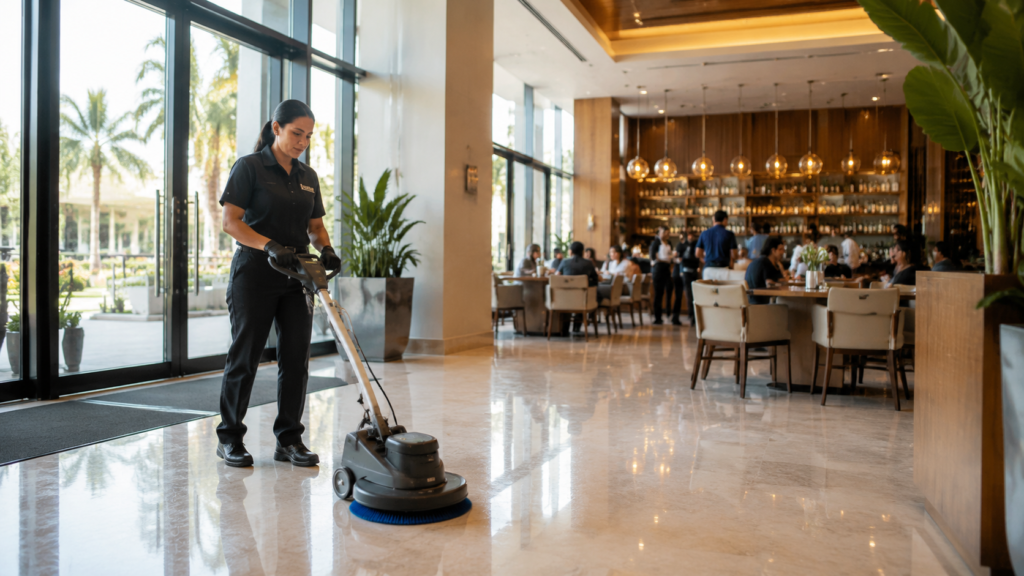
Professionals mitigate this risk through structured interim maintenance protocols. Instead of relying solely on deep cleaning at night, professionals deploy targeted daytime interventions. This includes spot-extracting carpets in high-traffic zones, buffing entryway floors to remove tracked-in soil, and executing rapid turnaround on dining tables and common surfaces. These targeted interventions prevent minor issues from compounding into major operational liabilities.
Specialized Deep Cleaning as a Baseline Reset
Even with excellent daytime maintenance, the cumulative effect of a high-volume summer season pushes facilities past their baseline cleanliness threshold. Day porters manage the surface-level reality of daily operations. They do not have the time, nor the specialized equipment, to extract deep soil from grout lines, degrease exhaust hoods, or sanitize the underside of heavy seating.
If deep soil is allowed to accumulate over the peak summer months, the evening cleaning crew will spend the entire autumn trying to catch up. This leads to operational fatigue, increased chemical costs, and a persistent visual dullness that customers notice. The facility slowly loses its original standard of care, and restoring it requires significantly more time and capital.
Professionals address this by scheduling Specialized Deep Cleaning during low-volume windows. Professional teams analyze traffic patterns to identify the optimal time for intensive restorative cleaning. This process resets the facility to its original baseline. By removing the accumulated deep soil, professionals ensure that the daily maintenance protocols remain effective and that the physical asset is protected from long-term wear and premature degradation.

Aligning Cleaning Protocols with Inspection Readiness
Facilities often pass routine, scheduled checks but fail surprise inspections during periods of peak operational stress. Management frequently assumes the cleaning vendor is handling compliance. However, if the vendor protocol is not specifically calibrated for peak summer volume, the facility will inevitably fall out of compliance during the busiest hours.
Regulatory compliance is not a static achievement. It is a continuous state of operational readiness. Failing an inspection during a summer surge damages relationships with landlords, insurers, and local authorities. It also introduces significant financial risk through unexpected fines and operational disruptions.
Professionals address this by designing cleaning systems around strict compliance verification. Commercial cleaning for high traffic businesses in the Bay Area involves documented checklists, color-coded microfiber systems to prevent cross-contamination, and EPA-registered chemicals applied at correct dilution ratios. The focus is on creating an audit trail that proves continuous compliance, regardless of daily visitor volume. When a facility is managed with inspection readiness as the primary metric, the operational anxiety surrounding surprise visits is entirely removed.
Final Operational Perspective
Operational problems in facility management rarely announce themselves with sudden, catastrophic failures. They compound quietly over time. A missed restroom restock on a busy Tuesday afternoon becomes a negative online review. A neglected floor scuff in July becomes a permanent stain requiring expensive replacement in October. Recognizing that summer foot traffic requires a structural adjustment to your cleaning protocols is the first step in protecting your operational continuity.
If your facility is preparing for the summer surge and you want to ensure your maintenance protocols can handle the increased volume, we invite you to review your current operational plan with our team.